Research
My work develops participatory design for responsible technologies across three registers: participatory action research designing for community participation in public sector AI, the study of how people build resilience to sustain individual and collective agency amid technological reconfiguration, and the epistemological foundations of technology underlying the empirical work.
Community Engagement in Public Sector AI
My doctoral research builds and deploys mechanisms for centering community experiences through participation in the development and deployment of public sector AI. It takes a relational approach, working through existing intermediaries in the information ecosystem to sustain community engagement.
Resilience: Individual and Collective Agency
This project develops resilience as the capacity to recognize, absorb, and strategically contest technology-driven reconfiguration while sustaining individual and collective agency. It examines how people actively draw boundaries based on their situated knowledge to interact with technology systems like AI that enter their workplaces, and proposes process evaluation for cases of deployment of LLM-based synthetic agents in institutions whose legitimacy depends on human participation.
Epistemology and Philosophy of Technology
The philosophical foundation for my current empirical and design works. It uses political theory and critical epistemology to ask how AI reshapes labour, perception, governance, and the production of knowledge, and argues for interdisciplinary frameworks that move beyond technical rationality toward socially grounded accounts of algorithmic systems.
Background
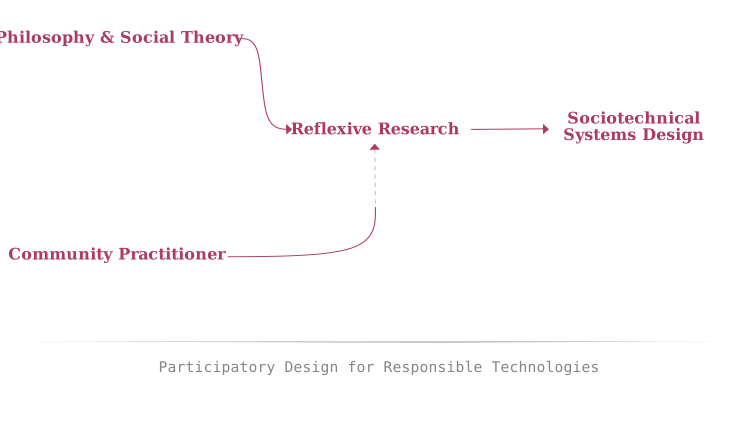
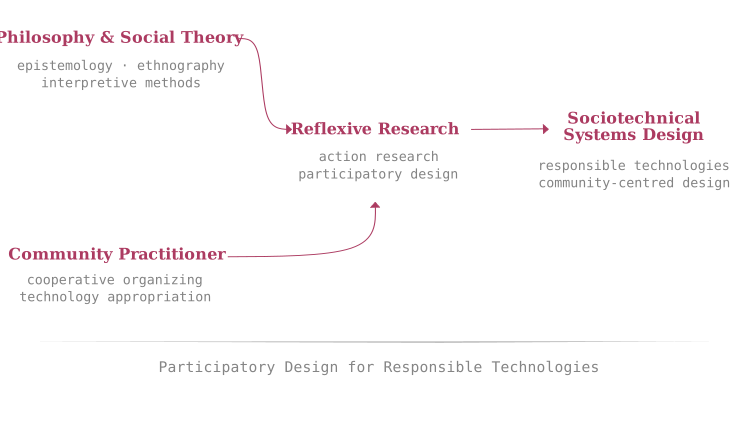
My work operationalizes philosophy and social theory for participatory design and system building. This constitutes my research methodology as well as my approach to empirical problems in HCI, primarily those dealing with responsible technology development and deployment.
Selected Honors
 Selected as a HAIL Graduate Student Awardee, Hub for AI and Data Science Leadership, University of Pittsburgh (2026–27) — interdisciplinary cohort on responsible data science and AI
 Awarded First Position, Allegheny County Case Competition (2024) — Humanitarian Advocacy for Neighborhood Disabilities and Support (HANDS): Data-curation and Tracking of Disability Benefits
- University Grants Commission National Eligibility Test for Assistant Professor in Political Science (2018)
- Served on the Editorial Board of Journal of AI Humanities, Chung Ang University, Seoul and Humanities Research Korea (2023-25)
Grants & Fellowships
- SCI Fellowship, Dept. of Information Culture and Data Stewardship, University of Pittsburgh (2024–25)
- Senior Research Fellowship, University Grants Commission (2020–23)
- Junior Research Fellowship, University Grants Commission (2018–20)
- International Travel Grant, Chung-Ang University, Seoul (2019)
Education
PhD · School of Computing and Information, University of Pittsburgh (Pursuing)
Coursework: Foundations in HCI; Public Interest Technology; Social Computing; Data-Centric Computing; Fairness, Accountability, Transparency and Ethics (FATE) in AI; Psychology of Learning and Development.
Master of Philosophy · Centre for Comparative Politics and Political Theory, Jawaharlal Nehru University
Thesis: ‘Artificial Intelligence and the Changing Forms of Work’ (2021)
Skills & Methods
In my research projects, I have worked in interdisciplinary teams for system development and testing, with colleagues across Computer Science, Information Science, and Policy domains. I currently mentor undergraduate students from the CS Department on system development for different aspects of my doctoral research.